


18 SepLiquid Waste Disposal for Michigan Manufacturers: Rules, Options and Common Mistakes
Most manufacturing plants generate more liquid waste than they think they do. Beyond the obvious process streams there is parts washer solution, coolant, oily water from sumps and pits, floor scrubber water, rinsate from cleaning, and whatever collects in the oil/water separator. Each has a disposal path, and each of those paths has a paper trail.
This is a practical overview for Michigan manufacturers: what counts as liquid waste, what the rules require, how a pickup actually works, and the mistakes that turn a routine service into a compliance problem.
What counts as liquid waste
Liquid waste is any waste stream that is liquid or contains free liquids. In a Michigan plant, the common ones are:
- Spent coolants and cutting fluids
- Parts washer and degreaser solutions
- Oily water from sumps, pits and separators
- Wash and rinse water from equipment cleaning
- Non-hazardous process wastewater
- Waste oil and fuel
- Contaminated stormwater from containment areas
If you want a more general breakdown of the categories, our post on examples of liquid waste covers them in plain terms.

Hazardous or non-hazardous: the question that sets everything else
Under RCRA, a waste is hazardous if it appears on a listed waste list or exhibits a characteristic: ignitability, corrosivity, reactivity, or toxicity. Solvent-bearing parts washer solution is frequently ignitable. Spent acid or caustic is frequently corrosive. Coolant is often non-hazardous but not always, and "often" is not a defense during an inspection.
That determination is the generator's responsibility, not the hauler's. It sets your generator status, your accumulation limits, your labeling, your manifesting, and your reporting. Get it wrong and every downstream step is wrong with it. Where a stream is genuinely hazardous, it moves into hazardous waste management with its own manifest and disposal path.
The Michigan layer
Michigan's EGLE administers the hazardous waste program at the state level, and Michigan rules are in places stricter than the federal baseline. Practical implications for a plant:
- Generators need a valid EPA/state ID number for hazardous shipments.
- Liquid industrial by-product (Michigan's category for non-hazardous industrial liquids) has its own shipping document requirements, and it does not simply escape paperwork by being non-hazardous.
- Accumulation time limits and container standards depend on your generator category, and exceeding a limit can move you into a category with much heavier obligations.
- Records need to be retrievable. In practice this is where most findings come from: the disposal was handled correctly and the documentation could not be produced.
How a liquid waste pickup actually works
- Profiling. The stream gets characterized, usually with process knowledge plus analysis. The profile determines the receiving facility.
- Approval. The disposal facility accepts the profile. This step is why "come get it today" is rarely realistic for a new stream.
- Scheduling and staging. Containers or a tanker, and confirmed access for the truck.
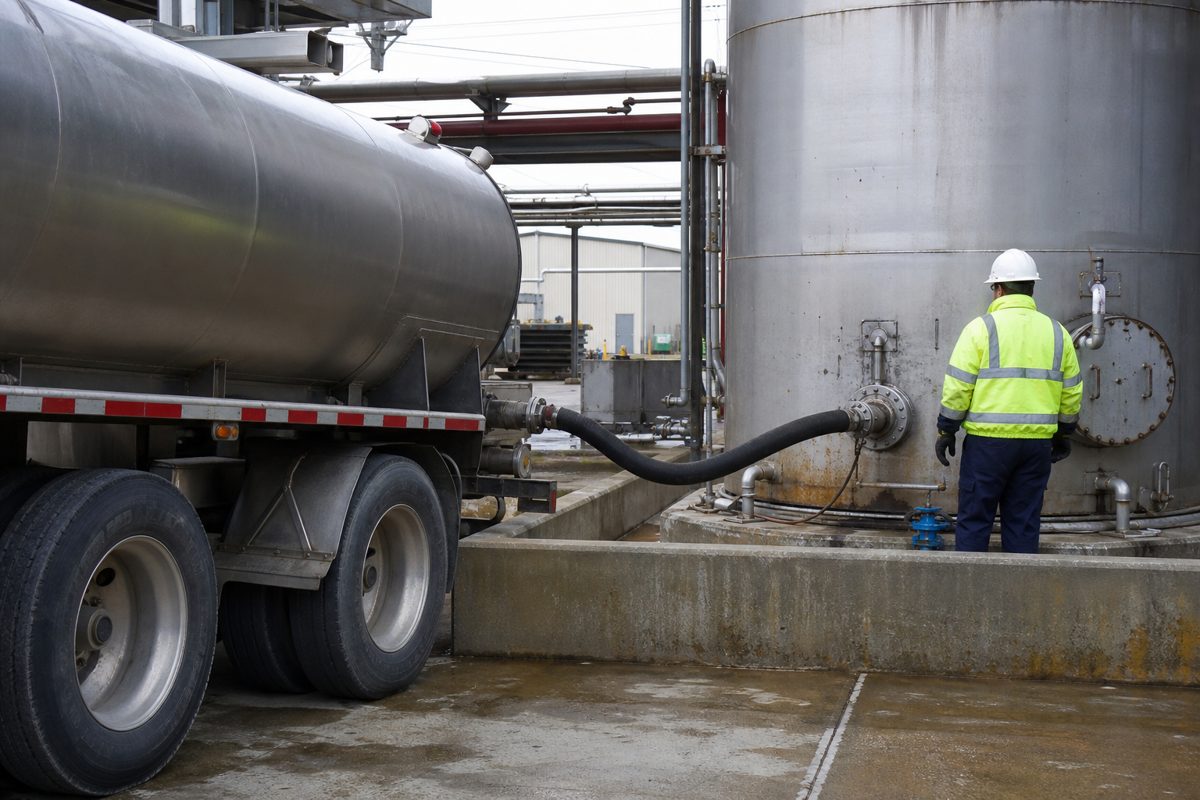
- Loading. Vacuum truck, tanker or drum pickup depending on volume and container type.
- Documentation. A manifest for hazardous waste, or the appropriate shipping document for liquid industrial by-product. Keep your copy.
- Disposal and confirmation. The receiving facility processes the load and returns the completed documentation. Chase it if it does not come back.
Ongoing programs run this on a schedule instead of a phone call, which is what makes the cost predictable. That is the substance of liquid waste management as a service: same profiles, same intervals, no scrambling when a tote is full.
Five mistakes that cost Michigan plants money
1. Mixing streams
Adding a small amount of hazardous waste to a large non-hazardous tank makes the entire tank hazardous. The cheapest mistake in this article to avoid and the most expensive one to make.
2. Treating containers as storage
Drums and totes sitting past accumulation limits, unlabeled, or with the start date left blank, are the most common finding in an inspection. Where drums are the format, drum management on a defined interval solves it structurally.
3. Assuming non-hazardous means no paperwork
Liquid industrial by-product still requires shipping documentation in Michigan. Non-hazardous is a disposal path, not an exemption from records.
4. Letting sumps and pits go until they fail
A sump cleaned annually is a routine vacuum job. A sump cleaned when it stops draining is often a sludge job with confined space implications and a much larger invoice.
5. Not knowing where the waste actually went
Generator liability follows the waste. Know the receiving facility, and keep the returned documentation on file.
Building a program instead of reacting
A workable liquid waste program has four parts: a current profile for every stream, defined accumulation points with correct labels, a scheduled pickup interval per stream, and one place where all documentation lands. Most plants already do three of those. The fourth is usually the one that shows up in an audit.
PROS Services has handled liquid waste for Michigan industry since 1954, from one yard in Roseville, covering all of Michigan and the Upper Peninsula, Northern Ohio, Northern Indiana and Metro Chicago. We handle profiling, transport, manifesting and disposal as one program, and the 24/7 line is answered by a PROS employee, not an answering service.
Call 810.982.7271 or request a review of your waste streams. To see the service in detail, visit liquid waste disposal.
Recent Comments