


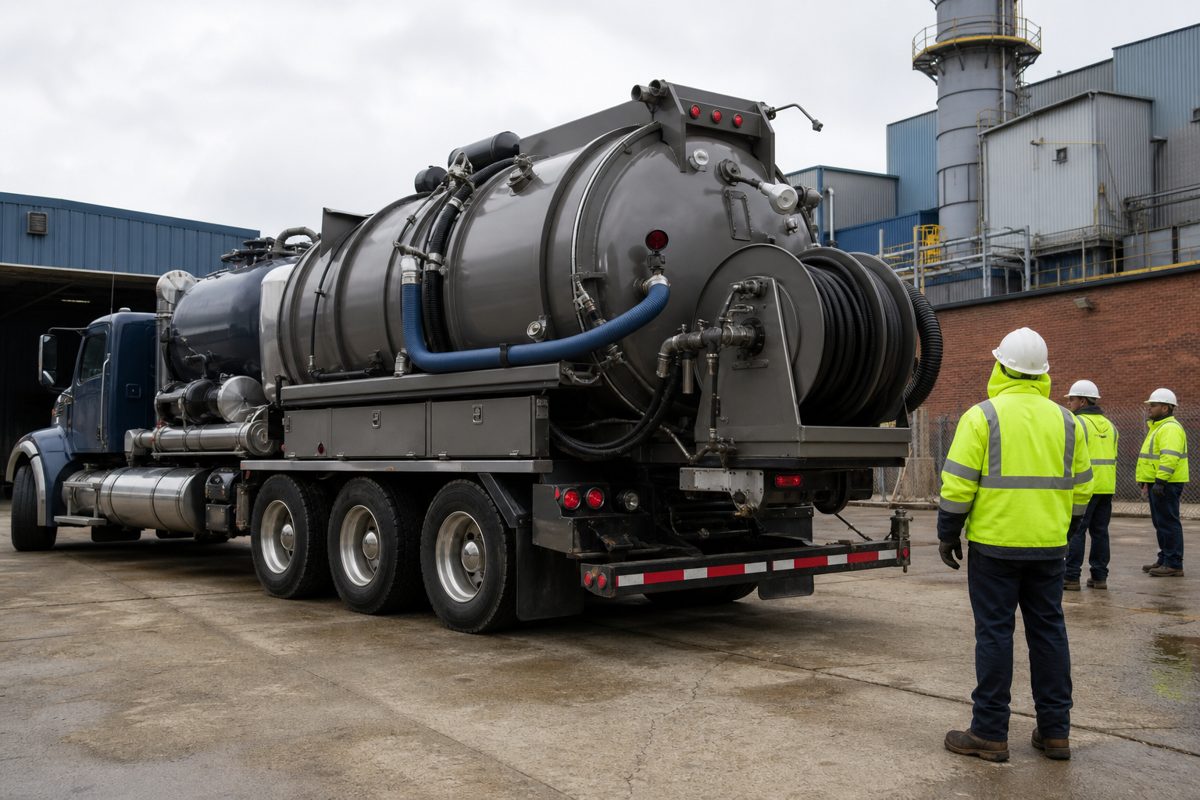
4 SepWhat Industrial Cleaning Costs in Michigan (and What Actually Drives the Price)
Ask three contractors what an industrial cleaning job costs and you will get three different numbers, usually because you gave them three different amounts of information. Industrial cleaning is not a catalog item. It is priced off crew size, hours on site, equipment on the ground, and how much waste leaves the property when the job is done.
This is a plain look at how these jobs are actually scoped and priced in Michigan, written for the maintenance managers and field supervisors who have to defend the number to a plant manager.
Industrial cleaning is priced on four inputs, not one
Almost every quote you will receive breaks down into the same four buckets:
- Labor. Crew size times hours on site. A confined space entry needs an entrant, an attendant and a supervisor at minimum, so headcount rises fast the moment the job goes inside a tank or vessel.
- Equipment. A vacuum truck, a jetter, a frac tank, air movers, blowers, or a rescue trailer. Each is a day rate, and mobilization is usually billed whether or not the unit runs all day.
- Waste volume and profile. This is the line most facilities underestimate. Disposal is priced by volume and by profile, and a drum of hazardous material costs several times what the same volume of non-hazardous washwater costs.
- Access and downtime. Night and weekend work, a shutdown window, a lockout/tagout sequence, or a tank you can only reach through an 18 inch manway all add hours without adding scope.

Why the same tank costs two different numbers
Two facilities can order "tank cleaning" and get quotes that are far apart. The difference is nearly always one of these:
1. What is left in the tank
A tank holding residual water is a different job than a tank holding settled sludge. Sludge does not pump like a liquid, so it needs to be broken up, mobilized and vacuumed, which adds hours and often adds equipment. If you are quoting tank work, tell the contractor the depth of the heel and the material, not just the tank size. See what sludge removal actually involves for the mechanics of that step.
2. Whether it is a permit-required confined space
If the space is permit-required under OSHA 1910.146, the job carries an attendant, atmospheric monitoring, a written entry permit and a rescue plan. That is not padding, it is the legal minimum, and it is the single biggest reason two quotes diverge: the cheaper one may have priced entry without standby rescue. Ask directly whether confined space rescue coverage is included in the number, or whether it is a separate line you will be buying later.
3. How the waste is classified
Waste classification drives disposal cost, manifesting and transportation. A facility that already has a current waste profile in hand will get a firmer quote than one that does not, because the contractor does not have to price the uncertainty. If the profile is unknown, expect a contingency in the number or a sampling step before the work is scheduled.
4. What happens to the liquid afterward
Washwater, rinsate and recovered product all have to go somewhere. That means transport, and it means a disposal facility. Liquid waste management is frequently a bigger share of the invoice than the cleaning itself on high-volume jobs.
What makes a job cheaper
Facilities that consistently get better pricing tend to do the same handful of things:
- Bundle the work. One mobilization covering three tanks costs less per tank than three separate visits. The truck and the crew are already on site.
- Schedule it, do not react to it. Scheduled work is quoted at normal rates. An emergency callout is priced as an emergency. Roughly nine out of ten of the jobs we run are scheduled, and those are the ones with predictable budgets.
- Have the space ready. Drained, isolated, locked out and accessible when the crew arrives. Crews waiting on a lockout are billable hours producing nothing.
- Know your waste. A current profile removes the contingency from the quote.
- Put it on a recurring interval. Annual or semi-annual cleaning on a known interval prevents the buildup that turns a routine job into a heavy sludge job.
What makes a job more expensive
- Unknown or mixed waste streams that require sampling before disposal.
- Restricted access: small manways, elevated work, tight interior geometry.
- Hot work, energized systems, or production that cannot fully shut down.
- Short-notice scheduling, night shifts and weekend windows.
- Discovering hazardous material after mobilization, which changes the profile and the disposal path mid-job.
What to send a contractor so the quote is accurate
If you want a number you can actually build a budget on, send this with the request:
- Asset type and dimensions (tank, pit, sump, vessel, trench, line footage and diameter).
- Material present and approximate volume, plus an SDS if one exists.
- Whether the space is permit-required, and any recent atmospheric readings.
- Access details: manway sizes, elevation, distance from where a truck can park.
- Your available window, including whether production stops.
- Site requirements: PPE standards, orientation, badging, escort rules.
- Where the waste goes, or whether you need the contractor to handle profiling, transport and disposal.
A contractor who asks these questions back before quoting is the one whose number will hold. A contractor who quotes a tank job from a phone call and a tank size is either guessing or planning to change the number later.
Fixed price or time and materials?
Both are legitimate. Fixed price works when the scope is well defined and the waste is known, and it moves the risk to the contractor. Time and materials works when there are genuine unknowns, and it stops you from paying for a contingency you may not need. The failure mode to avoid is a fixed price built on unknowns, because that price contains padding for a worst case, and you pay it whether or not the worst case shows up.
Getting a real number for your facility
PROS Services has been doing this work in Michigan since 1954, out of one yard in Roseville, serving all of Michigan and the Upper Peninsula, Northern Ohio, Northern Indiana and Metro Chicago. We quote from site conditions, not from a rate card, and the 24/7 line is answered by a PROS employee rather than an answering service.
Call 810.982.7271 or request a site assessment and we will walk the scope with you before anyone puts a number on paper. If you want to understand the service side first, start with our industrial cleaning services.
Recent Comments